Why We Start Sounding Like the People Around Us
Have you ever spent a few days with someone and suddenly caught yourself using their favorite phrase?
Maybe your friend always says “literally” in a very specific way, and then one day, without thinking, you say it too. Maybe you go home after months at school and realize your tone changes around your family. Or maybe you speak more formally with a teacher, more casually with friends, and completely differently when ordering food. At first, this may seem like simple imitation. But language is rarely only about exchanging information. It is also one of the ways we show closeness, distance, belonging, and identity.
In sociolinguistics and communication studies, this is often discussed through communication accommodation theory, which explains how people adjust their speech depending on who they are talking to. Sometimes we converge, meaning we speak more like the other person. Sometimes we diverge, meaning we make our speech more different to show distance or preserve identity (Giles, Coupland, & Coupland, 1991). These changes can happen through accent, speaking speed, vocabulary, sentence length, volume, and even the kinds of jokes we make.
Most of the time, we do not decide to do this consciously. We are not usually thinking, “I will now slightly change my voice so this person feels closer to me.” Instead, conversation works more like a social rhythm. Psycholinguists Pickering and Garrod describe dialogue as a process of “interactive alignment,” where speakers naturally align their language at many levels, from words to grammar to larger conversational patterns (Pickering & Garrod, 2004). In other words, when we talk to someone, our brain is not just forming our own sentences. It is also tracking the other person’s patterns and adjusting to them.
This is why friend groups often develop their own tiny languages. Inside jokes, repeated phrases, nicknames, and even strange ways of pronouncing words can become signs of belonging. From the outside, these habits may sound random or silly. But inside the group, they carry social meaning. They say, “You understand this because you are one of us.”
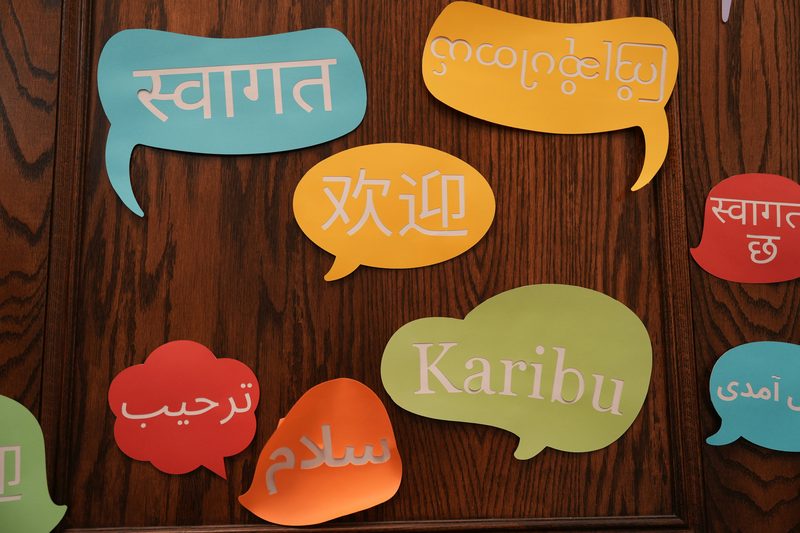
The same thing happens in more serious social contexts. A student may speak one way with classmates and another way with adults. A bilingual person may use one language at home, another at school, and a mix of both with friends. This does not mean one version is fake and another is real. It means language is flexible because social life is flexible. We do not speak into empty space. We speak to someone, and that someone changes the way our words feel.
Code-switching is one example of this flexibility. It can mean moving between languages, dialects, or styles depending on the situation. Sometimes it helps express an emotion that one language captures better. Sometimes it signals intimacy, like using a phrase only people from the same background would understand. Other times, it becomes a form of protection. People may soften an accent, avoid slang, or speak more “professionally” because they worry about being judged. In that case, language adaptation is not only about connection. It is also about survival.
This makes the question of authenticity complicated. If we change the way we speak around different people, are we being less ourselves? I do not think the answer is that simple. Speech is like clothing, manners, or body language. We naturally adjust it depending on where we are and who is listening. Speaking differently in different spaces does not automatically mean we are pretending. It may mean we are socially aware.
At the same time, there is a difference between choosing to adapt and feeling forced to hide. If someone feels they must erase their accent, home language, or natural way of speaking to be accepted, that can become exhausting. Accommodation can create belonging, but it can also reveal power. Who is expected to adjust? Who gets to keep speaking naturally? Whose way of speaking is treated as “normal”?
Maybe this is why voice feels so personal. Our way of speaking belongs to us, but it is also shaped by the people around us. A phrase from a friend, a tone from a parent, or a classroom habit from a teacher can stay with us long after the original conversation ends. Our speech becomes a small archive of the people who have influenced us.
So the next time you catch yourself using someone else’s phrase, maybe do not be too embarrassed. It might be funny. It might be accidental. But it also shows something deeply human. We listen. We adjust. We carry pieces of other people in our own voice.
Sources
Danescu-Niculescu-Mizil, C., Gamon, M., & Dumais, S. (2011). Mark my words! Linguistic style accommodation in social media. Proceedings of the 20th International Conference on World Wide Web.
Giles, H., Coupland, J., & Coupland, N. (1991). Contexts of accommodation: Developments in applied sociolinguistics. Cambridge University Press.
Pickering, M. J., & Garrod, S. (2004). Toward a mechanistic psychology of dialogue. Behavioral and Brain Sciences, 27(2), 169-226.